Time:
If you are sourcing aluminum foil for your business, you may have noticed two common product categories: household foil and foodservice foil.
At first glance, they may look similar. Both are aluminum foil products used for food preparation, wrapping, baking, and cooking. However, they are designed for different users and purchasing requirements.
For importers, distributors, wholesalers, and foodservice suppliers, understanding the difference can help you select the right specifications for your market.
In this guide, we will compare foodservice foil and household foil based on their applications, sizes, thicknesses, packaging, and purchasing considerations.
Household aluminum foil is primarily designed for home kitchens and individual consumers.
You can commonly find it in supermarkets, retail stores, convenience stores, and e-commerce channels. Because it is sold directly to consumers, convenience and retail presentation are important factors.
Typical household foil applications include:
Common specifications vary from market to market. For example, household foil may be available in sizes such as:
Smaller rolls are often convenient for household users because consumers usually purchase foil for occasional or everyday home use.
The packaging is also designed for retail sales. It may include colorful printing, barcodes, product information, usage instructions, and other consumer-oriented elements.
Therefore, household foil generally focuses on convenience, easy handling, and retail presentation.
Foodservice aluminum foil is mainly designed for commercial food preparation and professional kitchens.
Typical users include:
Unlike household users, commercial customers may use aluminum foil continuously throughout the day.
For this reason, foodservice foil often focuses on longer rolls, efficient dispensing, consistent quality, and cost-effective use.
Typical applications include:
Common commercial formats include:
Metric specifications are also widely available. The exact size and thickness should be selected according to your target market and application.
So, what is the actual difference between the two?
The following table provides a simple comparison.
| Feature | Household Foil | Foodservice Foil |
|---|---|---|
| Main users | Individual consumers | Restaurants and foodservice businesses |
| Main applications | Home cooking and food storage | Commercial food preparation |
| Roll length | Usually shorter | Often longer |
| Usage volume | Low to medium | Medium to high |
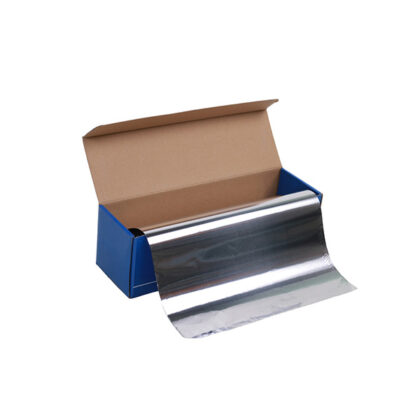
| Packaging | Retail box | Commercial dispenser box |
| Sales channels | Retail and e-commerce | Wholesale and foodservice distribution |
| Purchasing focus | Convenience and appearance | Efficiency, specifications, and cost |
| Customization | Retail-oriented | OEM and Private Label |
These are general market differences rather than strict industry rules. Actual specifications can vary according to the country, customer, and application.
One of the most noticeable differences is the roll format.
Household foil is often available in relatively short rolls because consumers usually do not need large quantities at one time.
For example, a household customer may purchase a 30m or 50m roll for regular cooking and food storage.
Foodservice customers, however, may use many meters of foil every day. Longer rolls can therefore reduce the frequency of roll replacement and improve working efficiency.
Common commercial formats include:
Foodservice foil can also be supplied in metric sizes such as 30cm and 45cm widths.
For importers, the best width depends on your customers.
For example, a bakery may prefer one width for baking applications, while a restaurant or catering supplier may require another size for food preparation and wrapping.
Therefore, you should confirm the application before choosing the final foil width and roll length.
Not necessarily.
This is one of the most common misunderstandings when comparing household foil and foodservice foil.
Foodservice foil is available in different thicknesses. It does not have to be thicker simply because it is used in a commercial kitchen.
Common thickness options may include:
Thinner foil may be suitable for general food wrapping and everyday applications.
Medium-thickness foil can provide a balance between flexibility and strength.
Thicker foil is often selected for more demanding applications such as BBQ, roasting, and heavy-duty food wrapping.
However, there is no single thickness that defines foodservice foil worldwide.
When purchasing aluminum foil, it is better to confirm the actual micron thickness instead of relying only on descriptions such as "standard" or "heavy duty."
Packaging is another important difference between household and foodservice foil.
Household foil packaging is usually designed for retail shelves.
Common features include:
The packaging needs to make the product easy to identify and convenient to use at home.
Foodservice foil packaging is designed for frequent use in commercial kitchens.
Common features include:
The goal is not only product presentation. The packaging should also make the foil easy for kitchen staff to dispense and cut during busy working hours.
For importers and distributors, customized packaging can also be important.
Depending on your market, you may require:
Working with a manufacturer that supports flexible packaging can therefore make it easier to develop your own product line.
Household foil and foodservice foil can be used for many of the same basic tasks.
Both can be used for:
The main difference is the scale and frequency of use.
A household consumer may use a few meters of foil for dinner or weekend BBQ.
A restaurant may use aluminum foil throughout the entire day for food preparation, cooking, storage, and takeaway orders.
A catering company may also require large quantities during events.
Therefore, foodservice foil is generally designed around the needs of higher-volume and more frequent commercial use.
The right choice depends on your customers and sales channels.
In this market, convenient roll sizes, attractive packaging, and retail presentation are important.
These customers often focus more on:
For example, a restaurant supplier may prefer a longer commercial roll because it reduces the need to replace the roll during daily operations.
If you are importing foodservice aluminum foil, do not compare suppliers only by the price per roll.
A low unit price does not always mean a lower actual cost.
Instead, compare the complete product specification.
Check whether your customers require 30cm, 12", 45cm, 18", or another width.
Compare the actual length of each roll.
Two rolls may have similar prices but very different lengths.
Confirm the actual micron thickness.
Do not compare products only by descriptions such as "Standard," "Regular," or "Heavy Duty."
Ask your manufacturer about the aluminum alloy used for the product and whether it is appropriate for the intended application.
Roll weight can help you understand the amount of aluminum in each roll.
For B2B purchasing, comparing roll specifications can give you a better basis for evaluating supplier quotations.
Check the box design, cutter, carton dimensions, carton quantity, and shipping requirements.
If you sell under your own brand, also confirm whether the manufacturer supports Private Label packaging.
Your MOQ may depend on:
Therefore, it is better to discuss the complete specification before requesting a final quotation.
Yes.
For importers and distributors, working with a manufacturer that can supply different aluminum foil categories can simplify sourcing.
A manufacturer may offer:
This can be useful if your business serves both retail and commercial customers.
Instead of managing separate suppliers for every foil product, you can discuss different specifications with one manufacturing partner.
At Eming Aluminium, we manufacture aluminum foil products for international importers, distributors, wholesalers, and foodservice suppliers.
Our product range covers both household and commercial aluminum foil applications.
We can support customized requirements for:
With 40+ production lines and a production capacity of approximately 1,800 tons per month, we can support different product specifications and order requirements.
Whether you need household aluminum foil for retail distribution or foodservice foil for restaurants and commercial kitchens, you can discuss your target specifications directly with our team.
Not always.
Foodservice foil is available in different thicknesses. The appropriate thickness depends on the application, market, and customer requirements.
Yes. Household foil can be used for some restaurant applications. However, commercial kitchens may prefer longer rolls and dispenser-style packaging for higher-volume use.
Common commercial formats include 12" and 18" widths with different roll lengths, such as 500 ft and 1000 ft. Metric sizes are also available.
Heavy Duty aluminum foil generally refers to thicker and stronger foil intended for more demanding applications. However, the exact specification can vary by market and supplier.
Yes. Depending on the order, manufacturers can customize dimensions, thickness, roll length, packaging, printing, and Private Label requirements.
Look beyond the unit price. Check the manufacturer's production capacity, product specifications, quality control, packaging options, MOQ, customization capability, and export experience.
Foodservice foil and household foil are both aluminum foil products used for food-related applications. However, they are designed around different customer needs.
Household foil focuses mainly on consumer convenience and retail use.
Foodservice foil focuses more on commercial applications, higher usage volume, efficient dispensing, and flexible specifications.
If you are an importer, distributor, or foodservice supplier, the right choice depends on your target customers, local market requirements, and intended applications.
Looking for foodservice aluminum foil with customized sizes or Private Label packaging?
Contact Eming Aluminium to discuss your requirements and request a quotation.
Related News




Get A Free Quote



Submit Request
